
A federal criminal investigation into systemic fraud related to audits of New York's Medicaid program is targeting numerous supervisors and employees at the state Health Department and the Research Foundation for the State University of New York.
Interviews with people familiar with the matter and documents obtained by the Times Union show that in recent weeks at least seven employees with those agencies received letters from federal prosecutors in Albany notifying them they are targets in the investigation. The letters say evidence is being prepared for presentation to a federal grand jury for indictment in a case involving fraud, health care fraud, falsification of records and conspiracy.
The targeted employees were encouraged to contact prosecutors to discuss a pre-indictment settlement, and to consult attorneys if necessary. The letters were sent by assistant U.S. Attorney Sara Lord, who specializes in white-collar crime cases.
Federal investigators with the U.S. Department of Health and Human Services are pursuing whether the scandal reaches into the upper levels of management for the SUNY Research Foundation and the state Health Department, according to sources briefed on the case. At stake is more than $22 billion in annual matching federal funds for Medicaid. The allegations are that Research Foundation workers, who were under contract with the state Health Department to audit the program, were pushed to manipulate data related to the percentage of ineligible people receiving benefits.
On Saturday, the Research Foundation issued a written statement that shifted focus to an arm of the Research Foundation in Buffalo. People briefed on the investigation said workers at the foundation's Albany headquarters are targets of the probe.
People familiar with the case said several Research Foundation workers have alleged they were fired or retaliated against after questioning the practice of altering data or manipulating information such as residency requirements of Medicaid recipients.
One such employee, Ava Dock, filed a civil complaint against the Research Foundation in U.S. District Court alleging that Research Foundation's ''purpose to underreport New York's error rate for Medicaid claims was to defraud the federal government ... in order to avoid the disallowance of federal matching funds for Medicaid to New York,''
The Research Foundation considers itself a private, not-for-profit agency though its leaders are mostly made up of top SUNY officials. The foundation handles about $1 billion annually in revenues, mostly in research grants from the federal government. Its workers also routinely conduct business on behalf of the state through government contracts, and many of its employees have state government jobs and state e-mail addresses.
This is not the first time NYS and SUNY Research Foundation Have Been Investigated for Fraud
http://www.timesunion.com/local/article/Feds-probing-Medicaid-fraud-at-SUNY-firm-557890.php#page-2
Showing posts with label Medicaid fraud. Show all posts
Showing posts with label Medicaid fraud. Show all posts
Saturday, June 11, 2011

Thursday, June 2, 2011
Public school, private dealings
Public school, private dealings
As the State University of New York looks for more independence, it should be doing all it can to earn the public's trust. Instead, SUNY wraps itself in the cloak of secrecy that already shrouds the SUNY Research Foundation.
The university refuses to release a report on its relationship with the Research Foundation. So much for shedding some light on this rather covert entity that handles $1 billion in grants annually and has been tainted by corruption and patronage allegations for years. SUNY says the report is "privileged."
And therein lies the problem -- with a secret foundation, with SUNY's outrageous pay hikes and housing allowances for top administrators, with a possible no-show job for the daughter of a former Senate majority leader, with the suggestion that higher education is beyond scrutiny: The air of privilege that SUNY exudes is sometimes breathtaking.
The report, done by legal consultant Hogan Lovells US LLP, is on the "Research Foundation/SUNY relationship." Paid for with $290,000 in public funds, the report is said to offer a comprehensive look at the Research Foundation. But Chancellor Nancy Zimpher, who commissioned the report shortly after coming to SUNY in 2009, considers it protected by lawyer-client privilege. SUNY won't even say why she had the report done in the first place.
So let's get this straight: The state-funded SUNY had to pay nearly $300,000 to understand its own murky relationship with the Research Foundation, yet the public that foots the bill for SUNY is told, "none of your business"?
It's all the more of public interest right now, when SUNY Vice Chancellor John J. O'Connor, who also headed the Research Foundation for 15 years, is facing charges from the state Commission on Public Integrity that he hired Susan Bruno, daughter of former Republican Senate leader Joseph L. Bruno, for a no-show job as Mr. O'Connor's special assistant. She resigned the $84,120-a-year job in 2009 amid Times Union inquiries about it. Mr. O'Connor denies the charges and has even asked that a court create an entity to monitor the commission's handling of his case.
Ms. Zimpher, who in recent weeks has been out talking about SUNY's contributions to the state, must appreciate as a public official that she has to take the bad with the good -- and divulge both whether she likes it or not.
If she and the trustees want the Legislature to give SUNY so much independence -- to set tuition, forge private partnerships and manage its affairs without legislative approval -- they have to show that SUNY is willing to be accountable to the public.
And if SUNY refuses, then other state officials should ask why.
This might be a good place for Comptroller Thomas DiNapoli and Attorney General Eric Schneiderman, who have teamed up to investigate and prosecute corruption in state government, to get started. The comptroller's and attorney general's offices, it's worth noting, were parties to the 1977 agreement that formalized the Research Foundation's role as fiscal administrator for SUNY's grants. It makes perfect sense that they'd want to look at how the foundation is handling things, starting with an audit by the comptroller.
And then let the rest of us in on the secret.
THE ISSUE:
SUNY says a report of keen public interest is "privileged."
THE STAKES:
Secrecy doesn't help SUNY's cause for greater public trust.
Sunday, May 29, 2011
How Not To Hide A Secret Love Child - Baby LK Report For May 29th 2011
Baby LK recaps the week in news for the child protection industry.
Saturday, January 29, 2011
Maura Corrigan Is A Brilliant And Refined Liar
Maura Corrigan Is A Brilliant And Refined Liar
This is my comment on the recent audit of Michigan's federal child welfare services Title IV-E reviews. I thought it best to post it here just in case the moderator takes it down.
This is my comment on the recent audit of Michigan's federal child welfare services Title IV-E reviews. I thought it best to post it here just in case the moderator takes it down.
 |
| Corrigan proud of false claims |
The Medicaid Fraud Control Unit in the Office of Attorney General does absolutely nothing except expend great amounts of defending its pattern of covering up Medicaid and other forms of health care fraud and antitrust representing the Superintendent of Michigan Children’s Institute, Bill Johnson,who represents the State of Michigan without appointment or election, with no oath of office on file with the Secretary of State, and possesses the power to overrule a decision of another state by denying ICPC interstate adoptions.
The following string of excerpts from federal and Michigan audits and evaluations is a working example of Medicaid Fraud in Child Welfare:
“Michigan staff, both at the Central Office and county level, did an excellent job of preparing for the review. Records were extremely well organized with necessary documentation of eligibility requirement readily located. The State provided a “reviewer friendly” environment for the review to take place. Of note was the willingness and untiring efforts made by the Program Office in leading this effort. DHS licensing and field staff, in partnership with personnel from the SCAO and the Wayne County Department of Children and Family Services, were most efficient in obtaining additional information or acting as resources during the onsite review. Additionally, DHS’ fiscal unit is recognized for the thorough and updated payment histories.
Michigan staff actively and enthusiastically participated in reviewing the cases.
(That’s because they successfully covered up the Medicaid Fraud.)
(That’s because they successfully covered up the Medicaid Fraud.)
Exemplary is the collaborative relationship between DHS and the State Court. This was evident not only in the presence of either the current or former Chief Justices of the Supreme Court at the entrance or exit conference, but also in the excellent quality of court orders observed during the review. In particular, the involvement of SCAO is noted for conveying title IV-E requirements to the court, instituting revisions to court orders and garnering greater consistency in the use of those revisions among the county courts. The ongoing collaboration between DHS and SCAO is a strong mechanism to foster an understanding of the need for and timely occurrence of appropriate and meaningful judicial determinations for children within both the child welfare and legal communities.”
“The state averted the loss of nearly $40 million in child welfare funding, thanks in part to the work of judicial branch staff.”
“If DHS did not improve, it faced a possible penalty of $22 million”…. “The U.S. Department of Health and Human Services conducted the second eligibility review of DHS’s case files for foster care maintenance payments issued between April 1, 2006 and September 30, 2006. Prior to the review, DHS conducted an extensive case file review to identify cases that did not meet Foster care: Title IV-E Program eligibility requirements. For cases that DHS determined did not meet the Foster Care: Title IV-E Program eligibility requirements, DHS changed the funding source on the cases to a funding source other than Foster Care: Title IV-E Program before April 1, 2006… As a result, those cases were not in the population reviewed during the federal review…The federal review concluded that DHS was in substantial compliance with federal eligibility requirements for the period April 1, 2006 through September 30, 2006.
We issued a qualified opinion on the Foster Care: Title IV-E Program. Our conclusion is different from the federal review because our sample included cases from the entire audit period.
During the (Michigan) onsite review, (federal) reviewers determined that criminal background checks were in evidence for all foster home files that were examined. In instances where children were placed in child caring institutions, reviewers determined that law enforcement checks had been done on administrators. Particularly noteworthy is Michigan’s practice of screening all licensed foster homes against its child abuse register on a weekly basis.
DHS had not developed a formal policy that defined when and for what service types criminal background checks and educational qualifications should be required as a part of a human service contract (includes foster care).
Health care fraud is health care fraud. Pettibone got punked by Corrigan, the same way Madoff pulled the wool over the eyes of the FCC for decades, but you have to give Maura credit, when it comes to cover ups of federal false claims and racketeering in the child welfare system, the gal is damn good.

"Qui tam pro domino rege quam pro se ipso in hac parte sequitur!"
Beverly Tran
An Original Source
An Original Source
DHS prevails in federal audit appeal
Wednesday, November 24, 2010
Maine Children's Services Administrators Need To Be Pubicly Flogged
I am deeply disturbed by the tone of this article.
The Maine program experiencing this magnitude of cost overruns has nothing to do with quality of services as most families struggle to access basic services for children, it has to do with basic incompetency of administration.
Maine is notorious, as well as many other states, to shift the burden of child welfare services to child welfare services. Yes this is redundant so allow me to expound upon this.
The basic revenue-maximization scheme is to place the child under the auspices of the state to access more financially beneficial funding streams.
Simply put, Maine will put a kid in foster care for reimbursement of administrative costs to provide basic services that should have been provided in the first place if there was leadership who was in possession of rudimentary elements of public administration.
Then, as kids, particularly special needs children, are snatched and placed into foster care services, national statistics become skewed showing how horrible parents are in the state. In reality, this is how Maine thought it would get away with trying to balance it budget on the billable souls of kids.
Here, reactively, the state begins to cut services provided to the community.
MaineCare Medicaid Policy Revision
Due to woefully inadequate management, the state must take away from the community to make up for its budgetary shortfalls.
So why are there shortfalls to begin with? Well, when you have child abuse propaganda machines conditioning public opinion to justify placing a child in foster care, for billing purposes of Medicaid Targeted Case Management, of course, on the idea that the state is providing educational special needs services due to child abuse and neglect, you have the fundamental elements of fraud, waste and abuse of federal and state funding.
And, if you dope these special needs kids with psychotropic meds, the state thinks that the rate of administrative payment increases.

Mainecare, its Department of Education, Department of Health and Human Services and its contactual partnerships need to be publicly flogged. If no one wants to flog them, then, contractually debar them.
See, an official of the State of Maine (a fan) informed me that the legislature, with advice and consent of the child abuse propaganda machines, was to "ease the rules" a bit when it came to accessing certain educational services. It seems parents were challenging the liberal application of psychological diagnosis (ADHD, Bipolar), so the "easing of the rules" allowed for greater access to educational services for children at a higher rate of reimbursement.
HHS Appellate Decision on Maine Department of Health and Human Services 2009 Targeted Case Management
The Maine program experiencing this magnitude of cost overruns has nothing to do with quality of services as most families struggle to access basic services for children, it has to do with basic incompetency of administration.
Maine is notorious, as well as many other states, to shift the burden of child welfare services to child welfare services. Yes this is redundant so allow me to expound upon this.
The basic revenue-maximization scheme is to place the child under the auspices of the state to access more financially beneficial funding streams.
Simply put, Maine will put a kid in foster care for reimbursement of administrative costs to provide basic services that should have been provided in the first place if there was leadership who was in possession of rudimentary elements of public administration.
Then, as kids, particularly special needs children, are snatched and placed into foster care services, national statistics become skewed showing how horrible parents are in the state. In reality, this is how Maine thought it would get away with trying to balance it budget on the billable souls of kids.
Here, reactively, the state begins to cut services provided to the community.
MaineCare Medicaid Policy Revision
Due to woefully inadequate management, the state must take away from the community to make up for its budgetary shortfalls.
So why are there shortfalls to begin with? Well, when you have child abuse propaganda machines conditioning public opinion to justify placing a child in foster care, for billing purposes of Medicaid Targeted Case Management, of course, on the idea that the state is providing educational special needs services due to child abuse and neglect, you have the fundamental elements of fraud, waste and abuse of federal and state funding.
And, if you dope these special needs kids with psychotropic meds, the state thinks that the rate of administrative payment increases.

Mainecare, its Department of Education, Department of Health and Human Services and its contactual partnerships need to be publicly flogged. If no one wants to flog them, then, contractually debar them.
See, an official of the State of Maine (a fan) informed me that the legislature, with advice and consent of the child abuse propaganda machines, was to "ease the rules" a bit when it came to accessing certain educational services. It seems parents were challenging the liberal application of psychological diagnosis (ADHD, Bipolar), so the "easing of the rules" allowed for greater access to educational services for children at a higher rate of reimbursement.
HHS Appellate Decision on Maine Department of Health and Human Services 2009 Targeted Case Management
Child services program over budget by 70 percent
AUGUSTA, Maine — The state’s Child Development Services program is over budget and will need more than $13 million to get through the current budget year. The state appropriation for the program is $14.9 million for this budget year.
“CDS has overexpended their account by close to 70 percent,” said Rep. John Martin, D-Eagle Lake. “The demand for CDS funding is for more than we appropriated.”
He said the overspending reinforces his opinion that the state should abolish the program, a move he supported 10 years ago.
James Rier, finance director for the Department of Education, said CDS has been undergoing a major reorganization required by the Legislature and standardizing services across the system has left the budget for the program short this budget year.
Rier proposed filling the hole by taking $5.7 million from a section of General Purpose Aid to Education that pays for the education of state wards and $7.4 million from an appropriation of cash from the general fund.
He said the agency is preparing a request for the supplemental budget that is expected to go to lawmakers in January that shifts some funds and asks for additional funding.
CDS provides both case management and direct services for children through age 5, with needs ranging from learning disabilities to mental health services. Some services can be covered under the state’s Medicaid program, called MaineCare, which means the federal government pays roughly two-thirds of the cost for those children that meet the eligibility standards.
The reorganization of CDS that took effect July 1, 2010, was in part a response to federal concerns that some of the services being billed to MaineCare were not allowed and there were inconsistent regulations between CDS sites across the state.
Both Education Commissioner Angela Faherty and Health and Human Services CommissionerBrenda Harvey were questioned by members of the outgoing Education Committee earlier this month.
“Whether or not they get services is determined by the eligibility criteria under the education act,” Faherty said. “If they are not medically necessary, they cannot be reimbursed by MaineCare.”
The loss of MaineCare funding is projected to cost the CDS program about $8 million in each of the 2012 and 2013 budget years and will be part of the next two-year state budget discussion.
Complicating an already complex situation is the DHHS shift to a new bill-paying system on Sept. 1, which has not gone as smoothly for school districts and CDS as it has for other MaineCare providers that bill for services through the system. Several districts told lawmakers earlier this month that they were experiencing billing problems and in some cases had yet to receive reimbursement for services billed in September.
“We heard a lot of concerns and we know they are going to have to be addressed,” said Sen. Justin Alfond, D-Portland, co-chairman of the outgoing Education Committee and assistant Senate minority leader in the new Legislature.
David Stockford, director of special services at DOE, said while there are concerns with the way the system has operated and its costs, it has been successful in preparing children for school and avoiding costs for school districts in future years.
“There are numbers of these children who, having received early intervention services, are able to enter the school-age programs with little or no service,” he said.
A study released in September found the problem of children with learning disabilities should be addressed early, but many are not being diagnosed until they start school. It indicated more money may be needed in the future to meet the need.
Only 22 percent of Maine children are being screened before starting school, according to census data. In the last school year, 812 children were first identified as needing special services when they started school. There were already 875 children receiving services through CDS.
Administration of Maine and Michigan were the inspiration for this educational video:
Administration of Maine and Michigan were the inspiration for this educational video:
Saturday, November 13, 2010
Policy Pimps and Welfare Queens
Here we have an elaborate scheme where University of Louisville is caught up in the middle laundrying Medicaid money in order for the state to maximize its revenues by claiming more Medicaid funds.
The levels of fraud, waste and abuse in social welfare programs do not really take place with its recipients and if so, it is minimal. Here is an example.
Many years ago, President Reagan made use of a term that has become synonymous with individuals on public assistance. That term is the "Welfare Queen".
The Welfare Queen was promoted as the representative icon of all welfare persons. She was the one who would wear mink coat, driving a Cadillac, while buying groceries with food stamps with 8 kids at home.
The nation has since adopted this distorted perception of welfare recipients as having children for money and being lazy.
It was the Heritage Foundation that created the image of the Welfare Queen. The story was based upon the fraudulent activities of one woman who fraudulently claimed around $80,000.00 in welfare.
I consider the Welfare Queen to be one of the greatest propaganda tactics of all times. Here you have an immediate, instant, on the spot available heuristic there to whip out every time there are stories such as the ones in the video, below.

A welfare queen is a pejorative phrase used in the United States to describe people who are accused of collecting excessive welfare payments through fraud or manipulation. Sensational reporting on welfare fraud began during the early-1960s, appearing in general interest magazines such as Readers Digest. The term entered the American lexiconduring Ronald Reagan's 1976 presidential campaign when he described a "welfare queen" from Chicago's South Side.[1]Since then, it has become a stigmatizing label placed on recidivist poor mothers, with studies showing that it often carries gendered and racial connotations.
A policy pimp is a phrase of parody used in the United States to describe a corporation or state, federally prosecuted of "illegally and wrongfully" filing false claims for reimbursement of welfare payments through Social Security programs of Medicare, Medicaid or TRICARE. Censored reporting on corporate welfare fraud began during the early 1960's, manifesting in the promotion of a national healthcare system, what is known today as medical insurance. Pharmaceutical corporations funded the design of university curriculum of social work and psychiatry, federal and state healthcare policies, and lobbyied as special interest groups to promote social programs which generated more customers who were mandated to take psychotic medications, allowed for clinical testing on foster children, all reimbursed through federal medical welfare programs. Since then, the appellation of policy pimps has become a national sensation, exposing the harmful nature of drugs such as Seroquel, Celexa, Geodon, Lexapro and Zyprexa.
Now, every time there is a major story of a pharmaceutical company or state being prosecuted for billions in welfare fraud, the story gets swept under the rug and reworked to blame the Welfare Queen by their corporately billionaire-funded minions, the Tea Party and their bought and paid for propaganda merchants. Tea Party campaigns are funded to stop socialism, their new name for welfare. Tea Party campaigns are also funded to distract the public from the true Welfare Kings.
Meet some Policy Pimps
The levels of fraud, waste and abuse in social welfare programs do not really take place with its recipients and if so, it is minimal. Here is an example.
Many years ago, President Reagan made use of a term that has become synonymous with individuals on public assistance. That term is the "Welfare Queen".
The Welfare Queen was promoted as the representative icon of all welfare persons. She was the one who would wear mink coat, driving a Cadillac, while buying groceries with food stamps with 8 kids at home.
The nation has since adopted this distorted perception of welfare recipients as having children for money and being lazy.
It was the Heritage Foundation that created the image of the Welfare Queen. The story was based upon the fraudulent activities of one woman who fraudulently claimed around $80,000.00 in welfare.
I consider the Welfare Queen to be one of the greatest propaganda tactics of all times. Here you have an immediate, instant, on the spot available heuristic there to whip out every time there are stories such as the ones in the video, below.

A welfare queen is a pejorative phrase used in the United States to describe people who are accused of collecting excessive welfare payments through fraud or manipulation. Sensational reporting on welfare fraud began during the early-1960s, appearing in general interest magazines such as Readers Digest. The term entered the American lexiconduring Ronald Reagan's 1976 presidential campaign when he described a "welfare queen" from Chicago's South Side.[1]Since then, it has become a stigmatizing label placed on recidivist poor mothers, with studies showing that it often carries gendered and racial connotations.
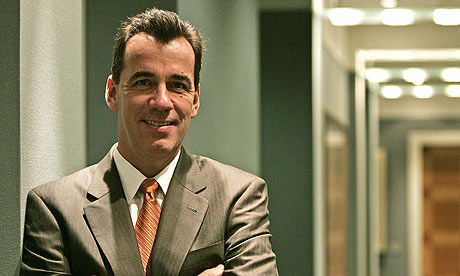 |
| David Brennan, AstraZenneca Policy Pimp |
A policy pimp is a phrase of parody used in the United States to describe a corporation or state, federally prosecuted of "illegally and wrongfully" filing false claims for reimbursement of welfare payments through Social Security programs of Medicare, Medicaid or TRICARE. Censored reporting on corporate welfare fraud began during the early 1960's, manifesting in the promotion of a national healthcare system, what is known today as medical insurance. Pharmaceutical corporations funded the design of university curriculum of social work and psychiatry, federal and state healthcare policies, and lobbyied as special interest groups to promote social programs which generated more customers who were mandated to take psychotic medications, allowed for clinical testing on foster children, all reimbursed through federal medical welfare programs. Since then, the appellation of policy pimps has become a national sensation, exposing the harmful nature of drugs such as Seroquel, Celexa, Geodon, Lexapro and Zyprexa.
Now, every time there is a major story of a pharmaceutical company or state being prosecuted for billions in welfare fraud, the story gets swept under the rug and reworked to blame the Welfare Queen by their corporately billionaire-funded minions, the Tea Party and their bought and paid for propaganda merchants. Tea Party campaigns are funded to stop socialism, their new name for welfare. Tea Party campaigns are also funded to distract the public from the true Welfare Kings.
Meet some Policy Pimps
Subscribe to:
Posts (Atom)